Friday, August 12, 2011

Ghana: Make Peace Happen Challe!


Even though I have left Africa, I could not avoid writing new posts regarding   events and places that called my attention during my stay.
I remember reading about Football Games as “one event that will allow you to truly see Africa” whilst in Ghana.
I hesitated. Is it another experience of people dealing in the worst way with a score they do not approve of?  Swearing at the opposite team fans and even racist remarks towards the players like it is in Ecuador?
Well Ghana, you’ve proved me wrong.
Accra was eager for Michael Essien’s Charity Match: Africa XI World XI.  Expats whose favorite sport was rugby were suddenly discussing the performance of the Black Stars, Ghana’s National Team. All of a sudden street vendors stocked themselves up with Ghanaian flags all over Accra and residents from cities such as Cape Coast – for once- were spending a holiday in Accra.


The celebrations started on May 24th at around 13h00 with the arrival of the players. Lisa Salmans, general manager of Citizen Kofi described the players as “hitting the ground running”. Citizen Kofi was one of the venues where the players had a party with fans, after Michael Essien’s fundraiser in Labadi Beach Hotel.
The Citizen Kofi venue, the night before the match was a  joyful, relaxed celebration.  A carefree Essien  kept joking around with fans. Sadly a not so friendly Didier Drogba, who looked annoyed when asked for photographs.


May 25th Arrived. People gathered in  their houses to share a few Stars and to pep themselves up for this celebration. It was African Union day and Ghanaians, proud to be the beacon of stability in the region, Hosts of the AU Match, had plenty of reason to celebrate, big time. Challe!

The match in itself was rather slow. Then again, these types of fundraising football games are made for the players and the public to enjoy. Baby Jet (Asamoah ) was part of the half time entertainment with Essien joining as a backup dancer. Children from SOS Children's Villages were the reminder of the topic that was being raised to public light: Make Peace Happen in Africa.


If there is one negative aspect of this match, had to be the obnoxious amount (if I could stretch the meaning and use of obnoxious) of pick pocketing. IDs, Mobiles, cameras and even Kebabs were the targets. Accra is a relative crime-free city but the pick pocketing for some put a damper on their celebration mood.
I ought to mention that Ghana was a land to which I arrived because I had no other option, and of which I had only seen the bad things of. People demanded money everywhere; Expats and tourists where constantly being ripped off, all the attractions or parks where dirty and let’s not even mention customer service (or rather, lack of). But once I was able to get out of my narrow minded set of “there is nothing like Abidjan” I was able to enjoy Accra. I enjoyed it quite a bit and at some point I called it home.  I even forgot of my blog during my stay in Ghana, but I got to admit it was because I was having a lot of fun, with the vibrant, relaxed nightlife and weekend trips.
Ghana is not on the world headlines (unlike Ivory Coast) for a good reason: Stability and a hassle-free way of living is a way the nation is described. And let’s face it: Stability rarely makes headlines.
 By the time of the football match I just needed re assurance of my feelings towards Ghana. And I could not have chosen a better time to admit Ghana had a special place for its people and is a place I definitely want to return to. 


Monday, July 25, 2011

Mi tio de Abobo II

Mi tío de Abobo es otro. Lo vi ayer en la tarde, en Abobo. Mi hermano anfitrión solo repetía el hecho que esta parte de Abidjan parece una aldea. Calles sin pavimentar y por primera vez no vi los comunes BMWs y Mercedes, a los que me acostumbré ver por todo Abidjan. Al menos, todos los distritos que visité hasta el día de ayer.
Mi tío se alegro de verme y salió a comprar un sucrerie, es decir una soda cuando llegue. Trabaja en el hotel de mi papa anfitrión, el hotel “Alex Le Grand
El Hotel es modesto y muy único. Si bien no se encuentra en el distrito de negocios Plateau, es lo mas marfileño que he visto, sin intentar a cualquier costo emular a los hoteles del que fue su país colonizador. Mi tío es el recepcionista y encargado del hotel, además de ser chofer de Gbaka y Wôro Wôro.  
Tonton Jean Pierre me explicó que existen muchos Dozos al momento en Abobo (cazadores tradicionales, se unieron a la milicia a favor de Ouattara) por un congreso en todo el proceso de reconciliación del país. Abobo según El, es el lugar más seguro en Abidjan, porque todos se conocen y está repleto de FRCI. Me explicó que ahora hay mucho trabajo que hacer y que en el ZOO no hay animales. Se murieron de hambre, ya que este distrito, que hace 3 meses atrás era apodado Bagdad, se convirtió al final de la pelea en un distrito fantasma y no había quien alimente a los habitantes del ZOO.
Tonton se reía y me decía que porque me regreso tan pronto a Ecuador, que la independencia de Costa de Marfil se celebrará días después de mi partida.
 Cuando estaba en mi casa en Marcory, meses atrás recuerdo como me preguntaba, intrigado y con una mirada lúgubre porque escogí Costa de Marfil como destino.
Me alegra tener la oportunidad de verlo en su vida normal, sonriendo.

Monday, July 4, 2011

The visit to Abidjan

A long time ago, when I had a short trip to France to meet with my parents in may, French Stations broadcasted from Yammousoukro, Cote D’Ivoire’s political capital, Ouattara’s presidential investiture in which,the presence of UN’s secretary General and the president of the former colonial power, France send a strong message to the international community : Cote D’Ivoire is ready to turn the page and become a peaceful country.

Is it that easy to turn the page and not to cling and what has been written in the past two decades, after two months?  Is it that easy to ignore the economy that took a plunge, the food rationing, water shortages, fear, and curfews? While Ivoirians just want “peace, work, go to a maquis (as local bar-restaurant are known here) and sleep”  the political crisis aftermath and the differences created between ethnic and political groups  within the country will take years to overcome.
I moved to Ivory Coast to volunteer in February, only to leave the country a month after to neighboring Ghana. I had the chance to travel  and stay for a few days in Abidjan at the end of april, to see if I could move back and visit a couple of friends, who took me around town, joking about the situation in Abidjan and what they had gone through.

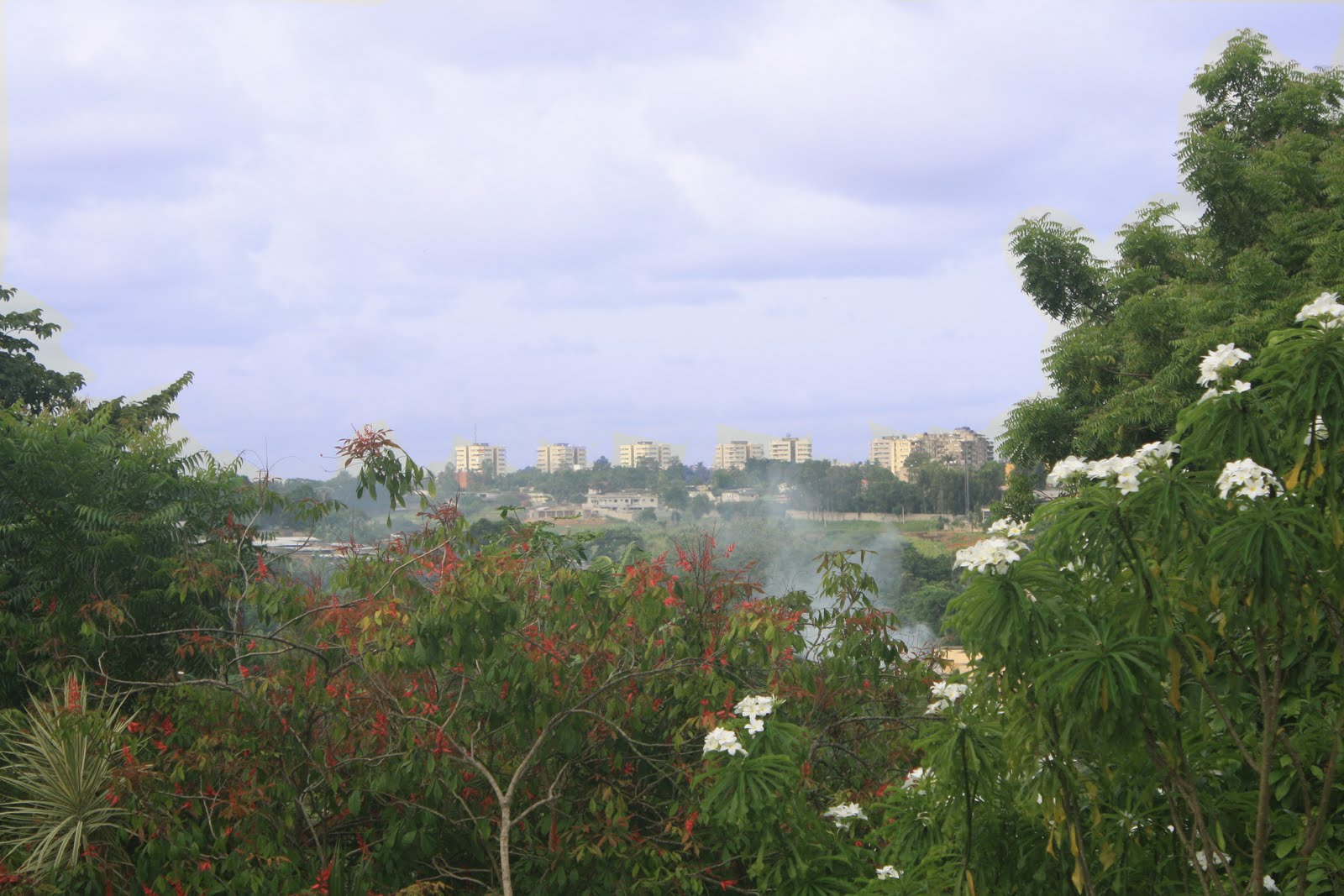
 View of Abidjan from the upscale neighborhood of Cocody where political figures such as the defeated president that refused to cede power Laurent Gbagbo, once resided.


Bullet holes in houses, like the one in this window, are a reminder of events that took place not that long ago.


Quartier des Ambassades, The Ambassadors’ Residential Area in Cocody where Gbagbo resided, suffered quite a lot of damage as FRCI (several militias that went under the umbrella of Republican Forces of Cote D’Ivoire, Ouattara supporters) advanced in order to take Gbagbo. This house on the way to Gbagbo’s home is a clear example of that.


 Ouattara’s victory, despite its loyal support from the international community was highly disputed specially in abidjan. While Ouattara is taking a reconciliation approach nowadays, through memorabilia watches and pins, its supporters, as soon as Abidjan fell, were a bit more straighforward.
The trace left by the burnings that took place in april. According to my friend bertrand* (as we walked around the neighborhood, he told me that people were burned down in the last days. Many Gbagbo supporters attacked Malians and Burkinabe inmigrants, who were blamed for the decay of the country the past decade. this divide was fueled by gbagbo propaganda.aTtrocities were commited by both parties during the 4 months of crisis. Bertrand told me corpses were lying for days while abidjan fell to Pro Ouattara forces, since no one could go out to the street. These signs of burning are for sure people that were burned alive, but cannot trace whom, why or by whom

The jaPAnese ambassador was evacuated by the United nations operations in cote d’ivoire (UNOCI) in a dramatic operation in april, around a week before gbagbo was captured. The residence was attacked by pro gbagbo supporters, called the young patriots. The street where the japanese residence is located, is a reminder of the battle to residents in abidjan.


AS FRCI encountered young patriots, the battle intensified with gun shots providing sound effects for Abidjan. everything on the way was burned down, as the car next to bertrand shows.


and we finally arrive! Gbagbo’s house is now guarded by UN forces and now that abidjan is calmed, it has 
become a tourist attraction.


On our way back we found some bullet shells in the street. I collected a few as souvenirs.
Happily though, the days that Abidjan’s background sounds was the sound of AK-47’s going off, seems far. And we all hope it stays that way.